
Find the Fish First: Daniel Fields' Game Plan for Attacking Pass Protections
Daniel Fields finds out who in an opponent's protection can be beaten before he looks at what protection it is.
"Before you get into anything else, ID the fish," Fields said. "What I mean by the fish is the person we can take advantage of on that offensive line."
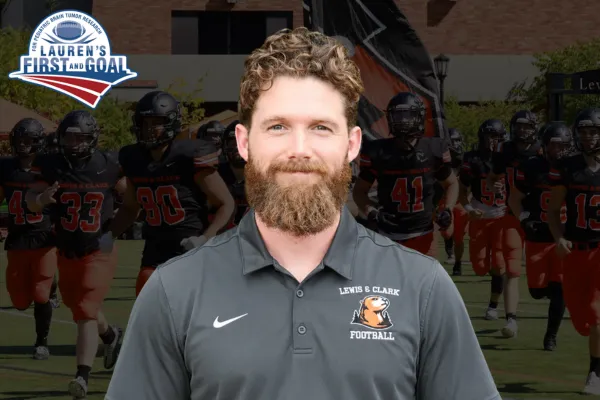
Fields is the defensive coordinator and assistant head coach at Lewis & Clark College in Portland, Oregon. He presented on identifying and attacking protections at a Lauren's First and Goal event. Before Lewis & Clark he spent ten years at UCLA: three as an athlete, two on the recruiting and offensive staffs, and five on the defensive staff. In his three years at Lewis & Clark, he said, the defense's sack and interception totals have gone up and its yards per carry has moved in the right direction.
His talk was mostly a protection-by-protection guide. The fish comes before any of it.
ID the fish
Fields' game plan week starts with scouting the offensive line. His defensive line coach breaks down every opposing line's strengths and weaknesses. Fields said that breakdown helps the players too, because it gives them "an idea of what we're facing, who we're facing, and some tools for us to attack them."
The second step is finding the fish:
"Is there a guy who is susceptible to specific moves? Is there a guy who can get beat in a one-on-one pass rush situation? Because we might not always be able to get a free pass rusher, but I can put our best guy in an advantageous pass rush situation."
The third step is isolating him. Can we get him against our best pass rusher? Can we make him block an off-ball pressure player? Can we run a stunt game that attacks him? Fields gets those matchups by changing fronts and back-end disguises.
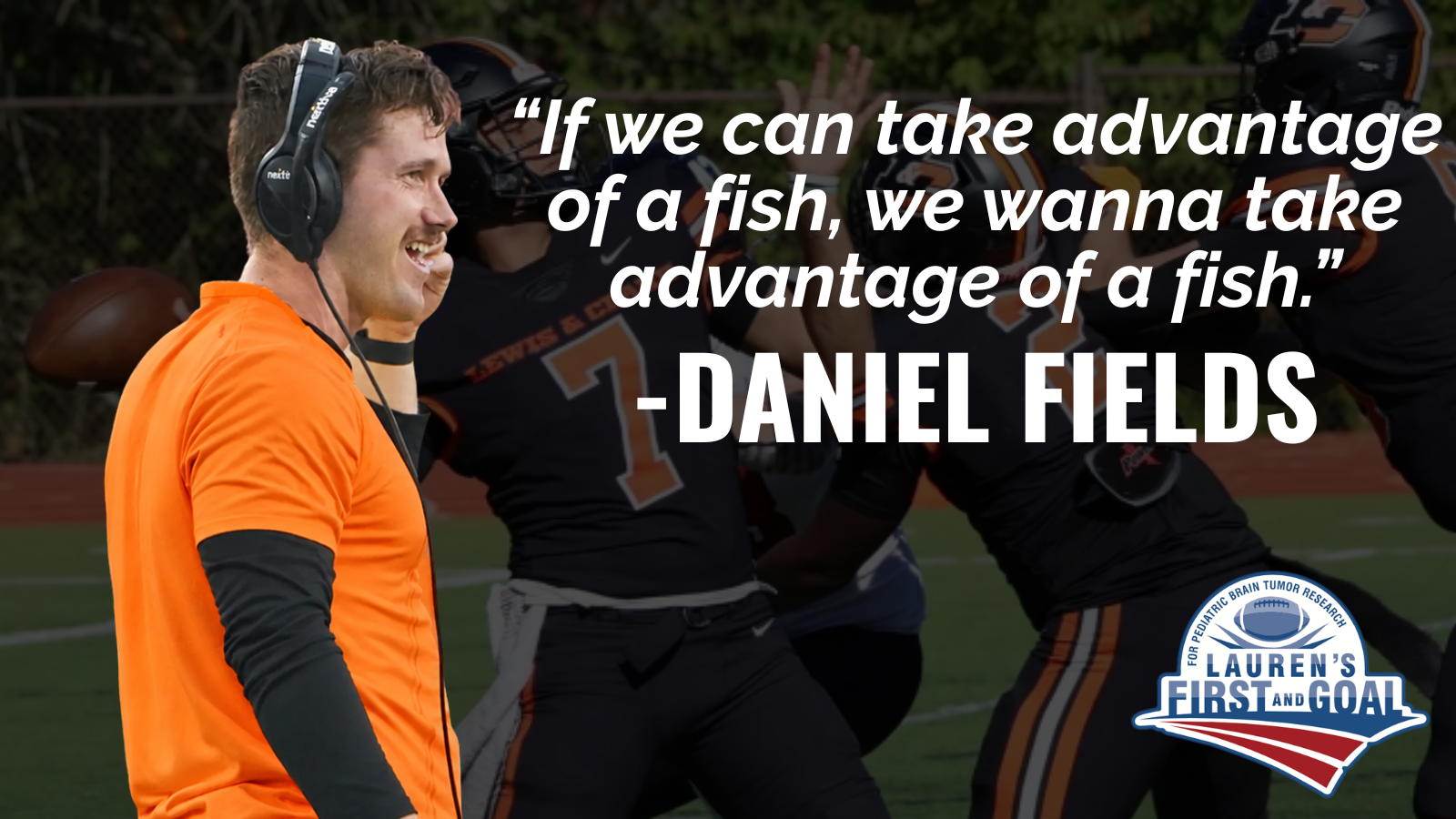
"If we can take advantage of a fish," he said, "we wanna take advantage of a fish."
In one game the fish was the opposing center, and Fields' staff knew he would struggle with speed on pressures. Lewis & Clark put a linebacker in front of the center's face before the snap, expecting the linebacker to have the advantage. He came free up the A gap and forced a hot throw. In another example against the same opponent, Fields kept "trying to put as much heat on that interior as possible," pulling the center to open the A gap alley and putting a man behind it. "The quarterback doesn't have time to make a decision."
Know the protection
The fourth step is identifying the protection. Fields sorts protections into drop-back schemes and play-action/movement schemes. Under drop-back he lists full slide, half-man slide, man, sift, and four-man slide protections. For most of them he asks the same scouting questions: when the opponent uses it, which formations it comes from, and which defensive looks bring it out.
Full slide: bring one away from the slide
In a full slide, the whole offensive line works an adjacent gap in one direction. Lewis & Clark has its own calls for five-, six- and seven-man slides.
Fields' questions for a full slide: Does it show up on first and second down or on third down? Does it come from open sets or from sets with a tight end in the core? Is it tied to specific defensive looks, or is it a check? Is it gap-dependent or man-dependent? "When the O-line slides a direction, do they track guys back or do they let it go?" And if the defense shows more than the slide can pick up, will they bring in an extra protector?
"Ideally you're bringing one away from the slide," he said. His front players get a heels/face read: "If I get the slide to me, I'm gonna drop. If I get the slide away from me, I'm going to track heels." Interior players who see the face of a blocker drop out underneath. That adds coverage players while the quarterback is still hot.
Fields showed several examples of Lewis & Clark deciding where the slide goes. The defense used overloads and pre-snap disguises to pull the slide to one side, then brought pressure off the other edge. When the staff has a good read on an opponent's slide direction, they build the pressure into the game plan or adjust from the sideline.
Controlling the slide doesn't always mean sending more rushers. In one clip Lewis & Clark rushed only four with seven in coverage. Because the defense had dictated the slide, one of its best pass rushers ended up on the running back. Fields called that "a situation you almost always wanna take." Against open sets with five blockers, his question was simpler: "Can you put more than they can block?" They brought six.
Have an answer for their answer
When a defense brings more than a full slide can handle, Fields said the offense will answer. The defense has to be ready for the back out fast to the field, screens, and speed option. After catching one opponent in full slide earlier in a game, Lewis & Clark put a rat underneath because it expected a middle screen. Against an empty set with six showing, two defenders knew before the snap that if motion started, one of them would leave the pressure to contain the back's route.
"This is something you got to work a ton of," Fields said.
The offense can also add a protector. In that case Fields adds a rusher, especially in man pressure, where the back end has been told it's on its own. "If we don't add in that pressure player, we might have some issues." One fix Fields showed was bringing the coverage defender assigned to the back into the box. If the back releases, that defender peels with him.
Half-man slide: find what moves the slide
Fields said half-slide protections are the ones defenses will see most often. On the slide side, the line covers the down lineman and the off-ball players, and the linemen have plenty of ways to handle movement there. On the man side, the guard and tackle are isolated, sometimes with the back in the protection too. Lewis & Clark calls a five-man half slide scat. Key means the back is in the protection, cross key means the back crosses from where he lined up, and Mongo is a seven-man version with both a tight end and a back in the protection.
Fields' main question is whether he can dictate the slide. On film he watches for communication from the quarterback or a line call, and then for what the defense did to trigger it:
"Maybe it's the nickel to the field being capped by the safety. Maybe it was the safety into the boundary leaning too heavy so he looked like he was capping the corner. Maybe it's one of the linebackers showed up to the depth of the D-line's feet."
Some teams always slide away from the back no matter what the defense shows. Against those teams, he said, "now you can attack." The goal is to get the best pass rusher to the man side, where he gets an isolated matchup.
From there, Fields' options include showing pressure to one side and bringing it from the other, getting the slide to one side to set up pick games, picking from the man side to force the offense to communicate, and bringing four weak from the slide. "If you can get that running back involved in stunt games, you're in great shape."
Each pressure comes with a plan for when the offense doesn't give the defense the look it wanted, so the defense can "always have the pencil last in the pressure game." Fields tells his players, "This is what we're trying to accomplish, this is what we need to do if we don't get what we're looking for."
One scat clip showed every role. Off-ball players read the slide, and Fields doesn't want them blocked by offensive linemen: "We never want our off ball players getting blocked by bigs." The D-end ran his blocker vertically up the field. That let the edge pressure player on the slide side keep going all the way to the A gap. On the man side, the rushers held the protection and stayed outside, so the lane stayed open. The play ended in an interception, which Fields called a key play in that game.
Cross key gave him a different opening. Coming off the play-action read, it was hard for the back to get across and be involved in the protection, and Fields used that to get an off-ball linebacker free.
Man protection: make the back choose
In man protection, the linemen usually have their matchups set before the snap and lock on, and the back is a scan player. Fields wants to know when an opponent goes to man (against bear, base four-down, or three-down fronts), how they pass off stunt games, and how the back scans: field to boundary, capped threat to the inside backers, or inside out.
He attacks the back's assignment. In a four-down man scheme where the back has both the Sam and the Will, Fields brings both. The offense has to leave one rusher unblocked and the quarterback has to throw hot.
He also changes which rusher a lineman ends up locked on. In one example the linebacker and the D-end swapped alignments. The tackle took the less threatening rusher, and the D-end ended up on the running back.
Sift: the BCB tool
Fields sees sift protections less often, mostly from high-pass teams, and probably more at the high school level than in college. In a sift, a lineman sinks back and either picks up interior pressure or helps outside. Before attacking it, Fields wants to know which fronts bring it out, who the sifter is (the lineman next to the 1-technique, the 3-technique, the 2i), where the sifter's eyes go, and who the back scans to.
Against three-down fronts, he uses a tool he calls BCB. Edge players attack the B gap first. If they get the face of the sifter, they work back to the C gap. If the sifter sinks straight back, they use him to pick the tackle. The nose works one side of the center fast. If the sifter squeezes to him, he lets the edge pick for him and wraps to that side.
"A nice little tool that you can use in a three down game that allows you to create pressure with three rushers," Fields said.
Four-man slide: the one-on-one it leaves behind
Fields sees four-man slides against certain looks, like an overload of pressure players or bigs to one side. He also sees them when the offense is hiding a weak center by sliding to the nose to help him. One way he attacks it is pulling across the slide with the mike and wrapping late, which leaves an isolation on the front side.
Getting the offense into a four-man slide also leaves the backside D-end one-on-one, and Fields will take that matchup when he likes it. "If you feel comfortable where you're look, you say hey, I feel good about our matchup on this right tackle. Hey, let's get the slide over here. Drop eight into coverage and let one of our pass rushers go one-on-one."
Movement: patience against flow
Fields' movement terms: sprint out, play action built off the run game, boot (run flow one way, quarterback protected as he boots back), naked (no one protecting the quarterback coming back), waggle (a puller in the protection), and dash (quick-game action one way, then a sprint out back the other way).
He scouts when an opponent uses movement, how it protects it, and what the quarterback does against free rushers. Against expected movement, Lewis & Clark often brings edge pressure to that side, traps with the corner, or buzzes someone to the flat. A formation with four to one side puts his defense on high alert for sprint out or boot.
Most of this section was about coaching the defensive line. In his film, D-ends stayed patient as the flow went away, ready for the boot coming back, and one of them finished with a sack against a naked. Against a waggle: "Attack that puller, play violent through it, finish on the quarterback." In true play action, he wants his linemen pushing and snapping down on protectors who are in an awkward position. When teams use tight ends in protection, the backers on them have to win, and Fields said that's "a challenge you have to give your guys and something that you have to constantly preach."
It's about the ball
"At the end of the day, guys, it's about the ball. Can you force the quarterback into situations where he's not as comfortable with that football? Whether you're creating sacks, whether you're creating TFLs in the run game or whether you're creating tight window throws where your DBs and secondary have an opportunity to make a play."
Want to Access Daniel Fields’s Full Presentation?
Go deeper into Daniel Fields’s approach to identifying and attacking pass protections, including finding weak links, manipulating protection slides, creating favorable pass-rush matchups, and building pressure answers for different protection schemes.