
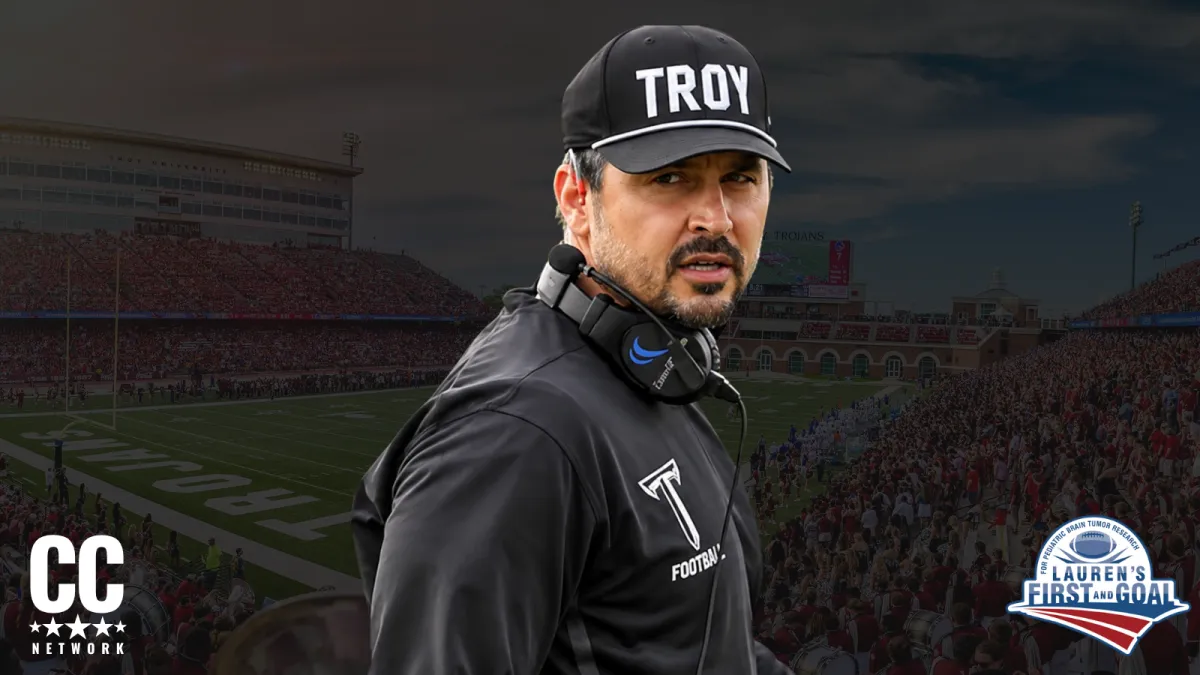
Why Adam Austin Grades His Quarterbacks Like a Report Card, Not a Box Score
Why Adam Austin Grades His Quarterbacks Like a Report Card, Not a Box Score
Adam Austin, offensive coordinator and quarterbacks coach at Troy University, walks through the quarterback evaluation system he developed and refined across multiple coaching stops in this clinic session from The Give, a Lauren's First and Goal podcast, breaking down how mechanics, accuracy, decision-making, degree of difficulty, and practice production factor into an objective daily grade.
Completions and yards don't tell a coach the whole story of whether a quarterback is actually developing. Adam Austin's answer to that problem is a grading system built from five separate categories, run through a GPA-style scale, and tracked daily across games, practices, and scrimmages.
Who Is Adam Austin, and How Did He Develop His Quarterback Grading System?
Austin is from Chicago and walked on at the University of Arizona as the ninth-string quarterback his freshman year, working his way up to a scholarship and starting a couple of games as a senior before an injury cut his playing career short. He played for the 2007 U.S. national team under John Mackovic, winning a gold medal in Japan.
His coaching path ran through several stops before this system took shape. He was a graduate assistant at Grambling State in 2008, an 11-2 season that ended with a national championship vote and a SWAC title, then spent two years as a GA at Marshall, first under Mark Snyder and John Shannon, then under Doc Holliday with Bill Legg running a wide-open triple option spread that pushed the ball down the field. He coached the 2011 U.S. national team's receivers to a gold medal in Austria. That same year, he became quarterbacks coach at Midwestern State, a Division II program in Wichita Falls, Texas, winning back-to-back conference titles before being promoted to offensive coordinator in 2013, a role he held for six years under Coach Maskell, picking up more conference championships along the way.
Austin then became offensive coordinator at Eastern Kentucky in 2019, a season that finished 7-5 with the offense ranked sixth nationally in red zone offense, first in the conference in fewest fumbles lost, and 22nd nationally in rushing, before an administrative change at athletic director and head coach ended that staff's tenure. When COVID hit shortly after, Austin coached tight ends and receivers at Garden City for five months, then took an offensive coordinator job at Missouri Southern for a COVID-shortened spring season, installing an entirely new offense in just eight practices and winning his only game that spring. Coach Whitnard then brought him to Tarleton to coach quarterbacks, where he spent the next several years building and refining the grading system described in this clinic session, before eventually taking his current role at Troy.
What Offensive Philosophy Shapes Austin’s Quarterback Evaluation System?
The system was built around a spread RPO offense with a physical downhill run game and a complementary vertical passing attack, the identity Austin ran at Tarleton, where the team produced both a 1,000-yard rusher and a 1,000-yard receiver in the same season. The average depth of target in the passing game was almost 14 yards, an aggressive, push-it-downfield approach. Because of that identity, Austin is direct that he has to tailor how he grades and develops his quarterbacks to match what the offense actually asks them to do, rather than applying a generic standard.
Why Does Austin Track Contested Catch Opportunities?
An aggressive downfield passing identity means receivers won't always be wide open, so part of the standard is winning contested, 50-50 opportunities. Using Pro Football Focus data, Austin studied close-coverage throw rates and contested-catch rates, comparing his own team to offenses with a similar downfield-first identity: Tennessee at the FBS level and Incarnate Word at the FCS level.
Tennessee threw into close coverage on roughly 15 percent of its pass attempts, about 70 of nearly 470 attempts across a full season, completing around 25 of those for a 36 percent contested catch rate. Austin's own team threw into close coverage 74 times and completed 33 of them, close to a 50 percent contested catch rate, a higher completion rate in those situations despite throwing into tight coverage more often than Tennessee did. Incarnate Word's numbers were close to Tennessee's, slightly ahead in contested situations.
Austin is upfront that comparing FCS-level defensive back play to the SEC has real limits given the talent gap. Still, the exercise told him his team wasn't generating much separation downfield and needed to deliberately practice contested-catch situations, while teaching quarterbacks that a downfield throw doesn't need to be perfect. It just needs to give a receiver a chance to go make the play.
Why Does Austin Start Quarterback Development With the Mental Game?
Austin's starting premise is that at any level or position, a quarterback absorbs more criticism and second-guessing than anyone else on the field or on the staff. Poise and the ability to lock into a process, rather than absorb that pressure, is what separates the quarterbacks who develop well.
He credits a page he received as a player from his college coach, John Mackovic, on quarterback development: knowledge, self-discipline, and concentration lead to consistency, and only careful preparation produces championship-level results. Austin teaches his quarterbacks that success brings too much credit, which can breed overconfidence, while failure brings too much blame, and both are outside distractions from the actual job. Every play should be treated as its own independent moment, with fundamentals as the anchor that produces consistency regardless of the noise around it.
How Does Austin Grade Quarterback Mechanics?
Mechanics is the first category in Austin's daily evaluation, covering games, practices, and scrimmages alike. Pre-snap, he looks at alignment, whether the formation is correct and the backfield is set up on the right side. Post-snap, he looks at footwork and eye placement. Each rep gets a plus or minus, which rolls up into a percentage grade.
How Does Austin Grade Quarterback Accuracy on a 4.0 GPA Scale?
The accuracy scale traces back to Mike Canales, Austin's own quarterbacks coach at Arizona and a mentor throughout his career, who came up with the idea of grading every throw on a 4.0 scale correlated to a student-athlete's GPA.
A 4.0 is a perfect throw that requires no adjustment from the receiver and is placed to protect him from a hit. A 3.0 is still accurate enough for a completion but slightly off, for example a deep ball that forces the receiver to slow down and get tackled right after the catch instead of scoring, or a throw just off target that costs some yards after the catch. A 2.0 is still a completion, but the receiver bailed the quarterback out, hauling in a contested catch in double coverage. A 1.0 is an incomplete pass where the receiver was open and the quarterback simply missed him. A zero covers a forced throw into coverage that's intercepted or broken up, or a throw sent straight to a defender.
Austin also divides the field into numbered quadrants so accuracy gets tracked by location, not just overall. Red zone throws are tracked by section of the end zone, while open-field throws are split by depth, past 20 yards versus the line of scrimmage to 20 yards, and by hash mark, left, middle, and right, with a separate set of zones for behind-the-line throws like screens. Each quarterback gets a daily overall GPA along with tallies and GPAs by zone, so Austin can spot a specific area where a quarterback's number is low, pull the clips, and build a plan to fix it.
Austin has tracked this system for about six years and has found that quarterbacks who stay consistently at a 3.0 GPA or better tend to be the ones who win the job and perform well. His quarterbacks treat it as a daily competition, tracked across one-on-ones, seven-on-sevens, and team periods, each wanting the highest GPA on the roster.
How Does Austin Grade Quarterback Decision-Making in an RPO Offense?
Because Tarleton ran an RPO offense, the quarterback made a real decision on every play. Austin sorts those decisions into four categories: needy, greedy, indecisive, and conservative. In this portion of the clinic, he explains needy as the ideal: the quarterback made the decision exactly according to the game plan and took what the defense gave him, whether that meant handing the ball off or throwing it.
What Is Austin’s “Game Changer” Grade for Quarterbacks?
After his staff was let go at Eastern Kentucky, Austin trained as an analyst with Pro Football Focus for several months and wanted to bring that same degree-of-difficulty thinking into his own grading system once he landed his next job. The idea is that not every completion is worth the same. A wide-open hitch against soft coverage is routine and earns no bonus, while a first-down throw made while avoiding pressure, or a ball threaded into a tight window, carries real added difficulty and should count for more.
On the positive side, a quarterback earns a 1 percent bump on his overall grade for plays like avoiding pressure to complete a first-down throw, fitting a ball into a window between two defenders on a route like a dig, or connecting on a contested deep shot. A 1.5 percent bump is reserved specifically for deep balls beyond 25 yards that hit the receiver in stride without forcing him to slow down. A full 2 percent bump is reserved for a genuine game-changing or game-winning play.
On the negative side, Austin won't dock a quarterback for something outside his control, like an unblocked defender causing an unforeseeable sack. He will take off half a percent for forcing a throw into coverage that gets broken up, and for sacks or fumbles when the quarterback had time to protect the ball or escape the pocket and didn't. A full percent comes off for a sack or fumble caused by holding the ball too long, or a wildly inaccurate or forced throw that turns into an interception. A percent and a half comes off for simply throwing the ball straight to a defender with no miscommunication involved. Two full points come off for a game-changing negative play, a sack-fumble or a pick-six that costs the game.
How Does Austin Grade Leadership and Practice Production?
Leadership is graded on character and whether teammates naturally gravitate toward a given quarterback. Practice production tracks whether a quarterback is moving the ball, picking up first downs, or scoring points during team periods, regardless of whether he's working with the ones, twos, or threes, with those production points added directly to his overall grade.
How Does Austin Track and Calculate Quarterback Grades Each Day?
Austin enters mechanics, accuracy, decision-making, game changer, and practice production data into a video platform, using DV Sport himself, though he notes the same approach works with Hudl or similar systems. He built his own Excel spreadsheets so that exporting data out of the platform automatically fills in his grade calculations, saving him from running those numbers by hand every day.
Quick Answers About Quarterback Evaluation
How can coaches grade quarterback accuracy beyond simple completion percentage? A GPA-style scale, grading each throw from 0 to 4.0 based on how much adjustment the receiver needed to make, gives a much more precise picture of accuracy than completion percentage alone, since a contested catch and a perfectly placed ball count the same in a box score but very differently on this scale.
Why track quarterback throws by field location instead of just overall accuracy? Breaking the field into zones, by depth and by hash mark, lets a coach identify a specific area where a quarterback is struggling, whether that's a certain distance downfield or a particular side of the field, and build a targeted plan instead of guessing at a general weakness.
Should every completed pass count the same toward a quarterback's grade? No. A difficulty-adjusted grading system credits a quarterback more for high-difficulty plays, like avoiding pressure to complete a throw or connecting downfield in stride, while not penalizing him for outcomes outside his control, like an unblocked free rusher.
What mental skills separate quarterbacks who develop well from those who don't? Poise and the ability to stay locked into a process are critical because quarterbacks face more second-guessing, praise, and criticism than almost anyone else on the field, and those outside distractions can pull them away from consistent execution.
How can coaches evaluate a quarterback's decision-making in an RPO offense? Sorting each decision into a small set of categories, based on whether the quarterback took what the defense gave him according to the game plan, creates an objective record of decision quality on every single snap rather than relying on a general impression after the fact.
Presented by Lauren's First and Goal
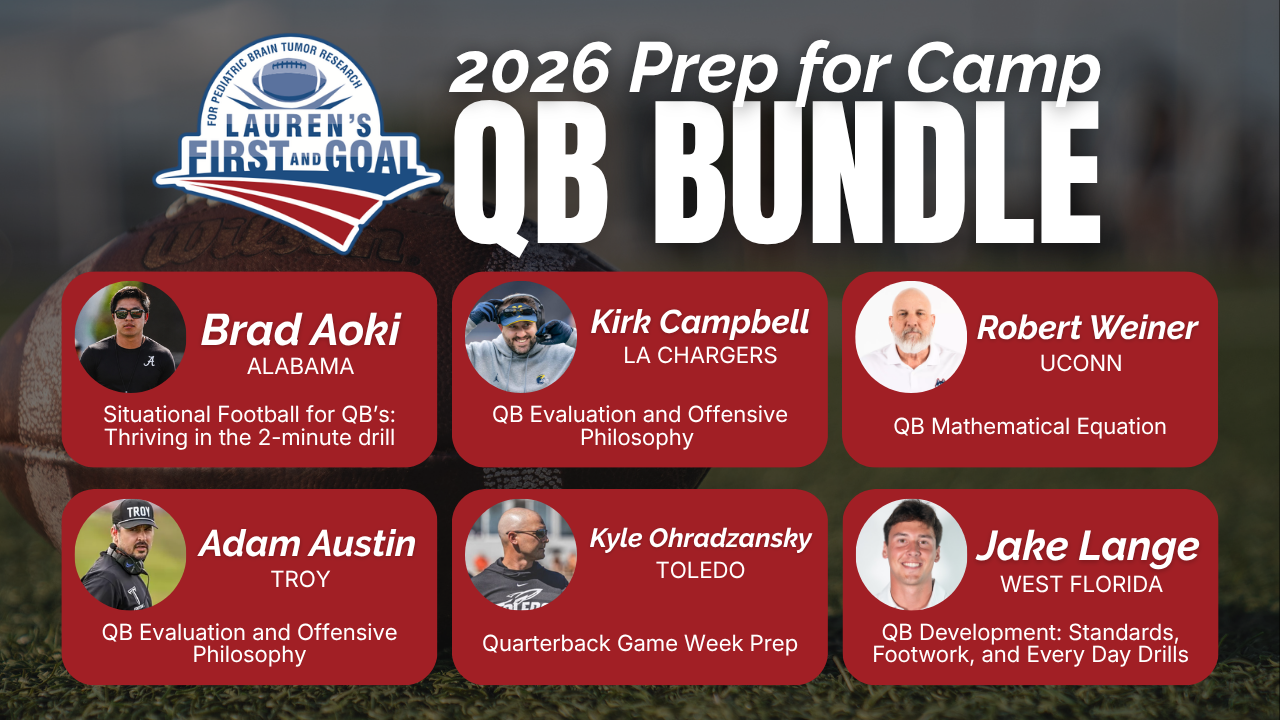
This session is part of the 2026 Prep for Camp Quarterbacks Bundle from Lauren's First and Goal, which also includes Brad Aoki (Alabama) on thriving in the two-minute drill, Kirk Campbell (LA Chargers) on quarterback development and coverage identification, Robert Weiner (UConn) on the quarterback mathematical equation, Kyle Ohradzansky (Toledo) on game week QB preparation, and Jake Lange (West Florida) on standards, footwork, and everyday QB development drills. Proceeds from Lauren's First and Goal courses benefit its mission. Learn more and get the bundle at Lauren's First and Goal.
Access the 2026 Prep for Camp QB Bundle
Access Our Free Lauren's First & Goal Content


